
Marketing technology became very good at finding people. Meanwhile, people acquired technology that made them harder to define — and more capable of shaping the outcome themselves. A customer can compare claims in seconds. An employee can supply the missing context. A specialist with a modest audience can influence a high-value professional network. A creator can reframe a campaign. A community can organize. A regulator can observe the reaction in public. None of this makes targeting obsolete. It makes targeting incomplete.
Targeting answers how to reach a person. The Empowered Actor lens asks what that person can do next.
The power shift hiding inside the media plan
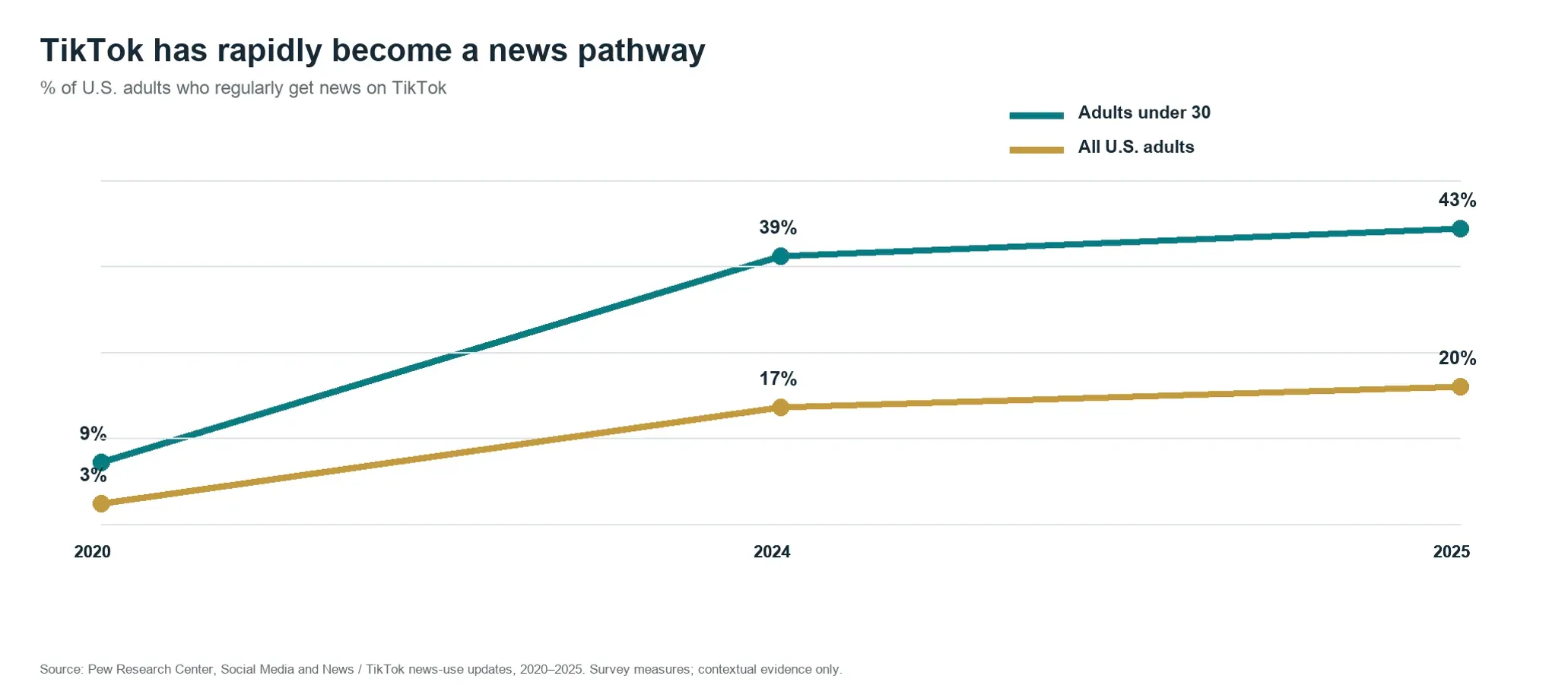
Conventional audience design is optimized for delivery: whom to reach, with what message, through which channel, at what cost. It often compresses a human being into the variables that make an impression purchasable. An Empowered Actor is defined by agency as well as attributes. People can choose, create, interpret, compare, challenge, organize, mobilize and carry an idea into relationships the brand does not own. Their power does not require celebrity scale. Trust inside a small professional, employee or community network may matter more to a business outcome than a large follower count. Pew Research Center found in a 2024 survey of 10,658 U.S. adults that 21% regularly got news from social-media news influencers; among adults ages 18–29, the figure was 37%. Pew’s separate analysis found that most of the 500 popular news influencers studied had no affiliation or background with a news organization. A related trend is visible in TikTok news use: Pew reports that the share of all U.S. adults regularly getting news there rose from 3% in 2020 to 20% in 2025, while the share among adults under 30 rose from 9% to 43%. These are not brand-purchase statistics, and they should not be presented as such. They show a broader redistribution: interpretation and authority increasingly travel through individuals and platforms, not institutions alone.
Participation is a design choice
For a CMO, the power shift is not merely a threat to control. It expands the creative brief. A campaign may be designed for exposure, or it may give customers, creators, employees or communities a credible role. A platform may invite people to repeat a line, or give them something useful to make, share, prove or change. Participation can create earned amplification and richer first-party signals, but those are consequences. The strategic question is whether the role offered has value for the actor and advances the intended business movement.
A call to action asks for a response. A role in the idea gives people a reason to participate.
From target to actor
Newlink does not throw away the target. It completes the picture. Orbital Thinking identifies the relevant actors and their power around the specific challenge. Shared Purpose tests whether the proposed role rests on credible common ground. Programs activate a bounded idea and define the evidence of movement before launch. The discipline matters. “Community” is not automatically strategy. “Creator” is not automatically credibility. “Engagement” is not automatically a comment. An actor is strategically important only when their interpretation or behavior can materially shape the chosen outcome.
Reach can be bought. The decision to carry an idea into a trusted relationship cannot.
The next generation of marketing advantage will still depend on great media and creative work. It will also depend on a more realistic theory of power: the people formerly described as endpoints now help determine where the story goes.