
Marketing has an engagement problem, and it begins with the word. A view is called engagement. So is a reaction, an event attendance, an employee-survey score and a long-term customer relationship. When one term describes everything from a thumb movement to trust, it stops helping leaders decide anything. Reach is not the enemy. Brands need salience. Leaders need to communicate. People need clear information. The executive question is what should happen after the message arrives.
Communication delivers meaning. Engagement changes the conditions for action.
Interaction is evidence, not the outcome
A click can be useful. It may signal attention, curiosity or intent. It does not automatically prove that a relationship changed or a business result advanced. Newlink defines Engagement as the management logic connecting meaning, relationships, experience, creativity and action around a business outcome. Its value depends on precision. For Brand, the desired movement may be participation, preference or demand. For Reputation, trust, legitimacy or resilience. For Culture, adoption, alignment or behavior. The metric follows the movement. The movement does not follow the easiest available metric.

The bridge from attention to value
For a CMO, the logic can be drawn simply: ATTENTION → PARTICIPATION → PREFERENCE → DEMAND → GROWTH This is not a universal funnel and no single campaign must deliver every stage. Attribution should remain disciplined. The point is to define the role of the work: what connection must change, what people should be able to do and what evidence would indicate progress toward the commercial outcome. Creativity becomes central because participation cannot be managed into existence through measurement. People need an idea, experience or role worth moving with. Effectiveness becomes central because originality without relevant movement is not enough..
The best creative idea is not merely memorable. It creates a meaningful role and produces evidence of movement.
A BOUNDED EVIDENCE STACK
Newlink’s measurement logic works across four levels:
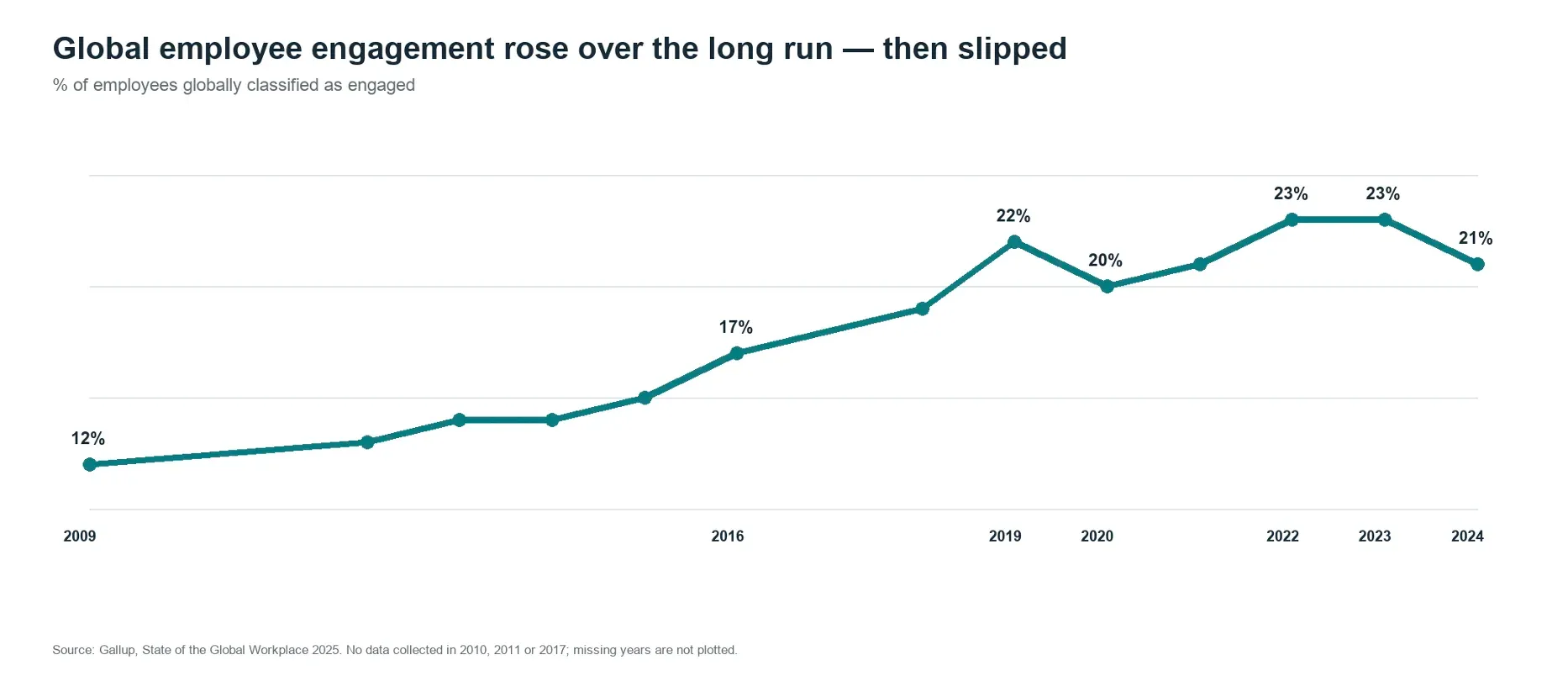
External research can support the business case without becoming a Newlink benchmark. Gallup’s 11th Q12 meta-analysis examines more than 180,000 teams across 347 organizations and evaluates the relationship between employee engagement and 11 business outcomes. Its scale reinforces a modest but important point: meaningful engagement can be studied against performance. Gallup’s global series adds another: engagement is not a permanently rising condition. It climbed from 12% in 2009 to 23% in 2022 and 2023, then fell to 21% in 2024. The definition, population and measures must remain explicit.
Design measurement before activation
Every Program should begin with four linked decisions: · The business outcome; · The Empowered Actors whose behavior matters; · The relationship or experience required; · The evidence that will indicate progress. That sequence protects executives from the post-campaign scramble in which available metrics are retrofitted to an undefined ambition. It also creates a better creative brief. Teams know whether they are designing for exposure, participation, preference, trust, adoption or another specific movement.