
The most expensive fiction in corporate life may be the idea that change is a project. Projects have sponsors, milestones and an end date. The environment now confronting large organizations has none of those conveniences. Technology cycles turn while technology programs are still being approved. Customer discovery moves from search engines to creators, retail platforms and AI interfaces. Employees learn that a role is changing at roughly the same time their managers do. A geopolitical rupture in one market alters costs, trust and expectations in another. The plan has not disappeared; its half-life has shortened. This is not a poetic observation. It changes the economics of management. When assumptions decay quickly, value migrates from prediction alone toward organizational navigation: the capacity to sense a shift, interpret it across functions, make a coherent choice and move before internal fragmentation consumes the advantage.
Permanent change turns alignment from a communications task into productive infrastructure.
The stability premium has become a navigation premium
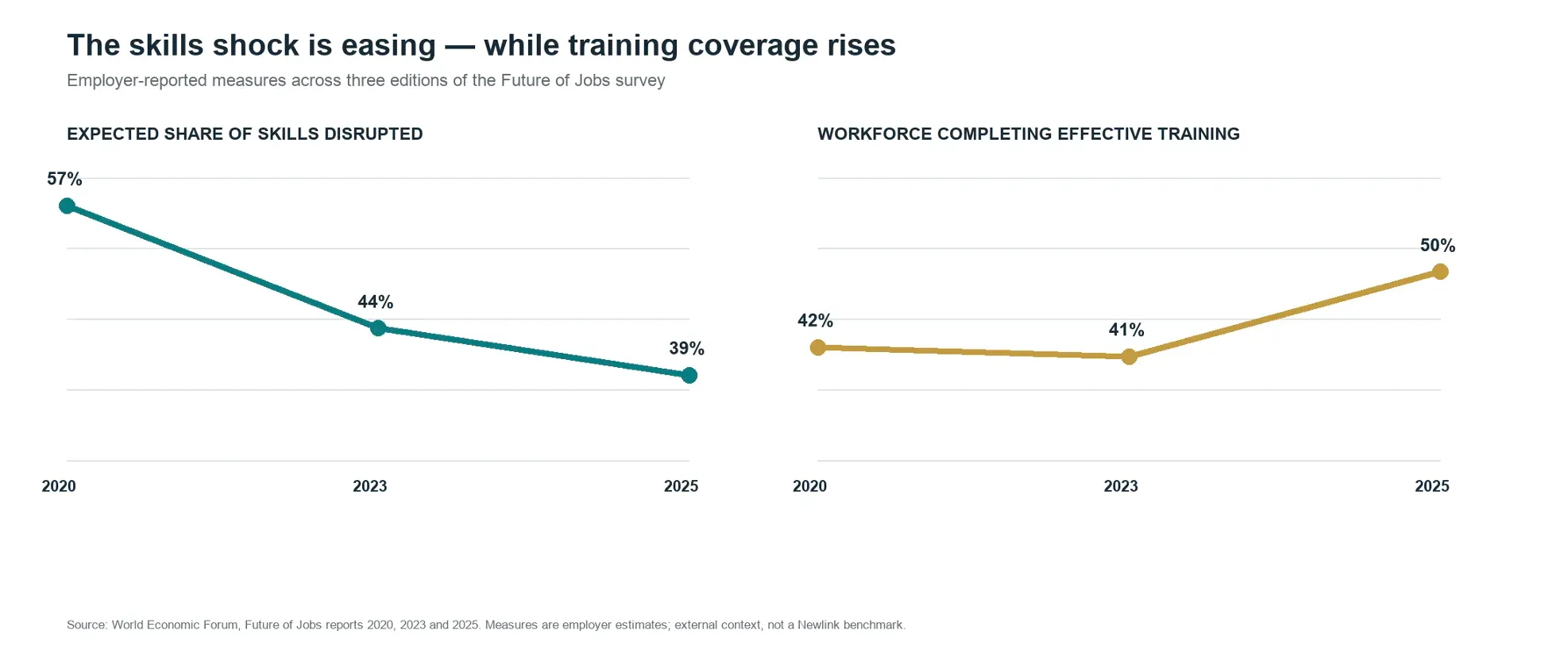
For decades, the standard transformation story was reassuringly linear. Management defined a future state. A program office divided the journey into workstreams. Communications explained why change was necessary. The organization absorbed the disruption and eventually reached a new normal. That model survives because it is legible. It also rests on a fading assumption: that the world outside the transformation will remain stable long enough for the organization inside it to catch up. The World Economic Forum’s *Future of Jobs Report 2025*, based on input from more than 1,000 employers, says employers expect 39% of workers’ core skills to change by 2030. It also identifies skills gaps as the most frequently cited barrier to business transformation. The precise forecast will differ by sector and company. The management implication is broader: capability renewal is no longer a phase between periods of stability. It is part of operating the business.
Fragmentation is the hidden tax
The obvious risk is that a strategy becomes obsolete. The quieter risk is that the organization responds in pieces. Marketing adjusts the promise. Corporate Affairs manages a new expectation. HR launches a behavior initiative. Operations changes the experience. Each decision may be defensible. Together they may tell four different stories about the same company. For a consumer-goods group, that can mean brand communication that outruns supply or product experience. For a bank, a digital convenience promise can collide with the lived reality of controls, branches and contact centers. For a mining company, an operational decision can become an employee, community, regulatory and investor issue before the specialist teams have agreed on what changed. The cost appears as duplicated research, slower approvals, conflicting signals, trust leakage and exhausted employees. It rarely arrives under a budget line called fragmentation.
The company can move in every function and still fail to move as one organization.
From forecasting to an Engagement capability
Leaders still need scenarios, plans and specialist expertise. The upgrade is to connect them through an always-on capacity to see the relevant system and act with focus. Orbital Thinking keeps the field visible: the Empowered Actors, interests, tensions and Active Connections that can alter the outcome. Shared Purpose identifies credible common ground without pretending conflict has vanished. Orbital Strategy brings the people responsible for execution into the choices and trade-offs. Programs turn that alignment into bounded work with owners, timing and evidence. This is Newlink’s definition of Engagement as a management logic. It is not a universal score and it is not a larger communications scope. It is the connective capacity that keeps meaning, relationships, experience, creativity and action organized around a business outcome. THE OPERATING SHIFT OLD ASSUMPTION → Change interrupts a stable system NEW REALITY → The system and the organization change together OLD RESPONSE → Announce, cascade, implement, stabilize NEW CAPABILITY → Sense, connect, choose, activate, learn VALUE CREATED → Faster coherence and Measurable Movement For a CEO, the test is whether the enterprise can revise a decision without revising its identity every quarter. For a CMO, it is whether brand building, performance, reputation and customer experience can respond to a new signal without breaking the promise. For a transformation leader, it is whether people have a credible role in the change rather than merely receiving its explanation.
Speed does not come from skipping alignment. It comes from creating alignment before the next signal forces the issue.
The Unknown Era is therefore less about uncertainty than about coherence. The winning organization will not be the one that predicts every disruption. It will be the one that can repeatedly answer three questions: What changed in the system around us? Which relationships now matter to the outcome? Where should we focus without losing sight of the whole?